
For those of us who have had the opportunity to either qualify for or complete tertiary education, the common mistake is to think that your career only begins once you receive your certificate at graduation. Your career actually begins just after you have finished high school, which feels overwhelming and sometimes this period happens to creep up on us without warning. Suddenly, you are no longer a student but must sustain yourself and build a career.
Depending on your institution, there are opportunities for work-integrated learning while you complete your studies. If you were in a position similar to mine, work-experience was unrelated to my institution and instead my passion laid the foundation helping me maintain a go-getter energy and to put myself out there to gain experience (mostly unpaid). Once I completed my studies, even my side hustles could not keep me busy enough, and I felt that there was crucial industry experience that I still needed to tap into.
Although my role focuses on social media, the NPO and NGO space is saturated with tasks but very little means to complete them, and so I have taken on further roles of podcast production, working in the funding department, as well as event/project planning in correspondence with the directors of iKasi Creative NPC.
My Monthly Tasks:
Social Media Calendar
Social media calendars include the content, caption, tags, and of course, the time and date. To be efficient in planning and social media management, it is best to complete a month’s calendar at least 10 days before the beginning of the month so that you can begin scheduling posts so that your company/organisation is included in the process and is made aware of the relevant strategies, themes, or changes.
Scheduling Posts
Honestly, scheduling posts is one of the best features on media platforms. It offers you the opportunity to plan your media releases in advance, and furthermore, to post at peak times consistently. Once the post has been created, approved by the director or manager, it is crucial to schedule the post to avoid missing the algorithm’s flow. Moreover, scheduling your posts will help build consistency on these platforms for your client.
Blog Writing
Blog writing is not as simple as it sounds. There is a style, form, and a tone that must emerge with every article. Furthermore, I must write these articles in a way that always conveys iKasi’s main mission and message. Blog articles must be concise, direct, and encourage readers to engage further with iKasi, whether as prospective partners, learners, or donor stakeholders.
Content Creation
Another task that is not to be taken lightly. Creating content in the digital age is easier than ever, especially with your mobile phone. My job, though, is to create content that stands out from the rest.
You can create content using anything, so long as you have a way to digitise it. My favourite tool for content creation is Canva, especially as you can add graphics and colours that make your content pop and glow. To get accustomed to the tools on Canva, I spent a few hours exploring each setting and let myself get creative.
It is important to remember that when you are creating content for a client, you must utilise their brand (i.e. colours, fonts, logos, and slogans). Content creation is an act of creating, but it also requires the creator to be measured and considerate of content management, consistency, and flow.
Editing & Post-Production
The main goals with editing and post-production is to understand the workflow process from import to export, to produce and deliver content that conveys a message with a narrative rhythm. Since I have been working on iKasi’s podcast (The Influence), I further understand the differences between technical editing (cutting and syncing) and creative editing (the pace, colour grading, mood setting).
I follow a steady process in steps, laying the foundation with transferring and organising files. Editing takes time, and you most likely will take days to edit one piece of content in video production, which makes file organisation really important. I then move onto building the narrative structure; when it comes to the podcast episodes, I work closely with the script prepared before recording.
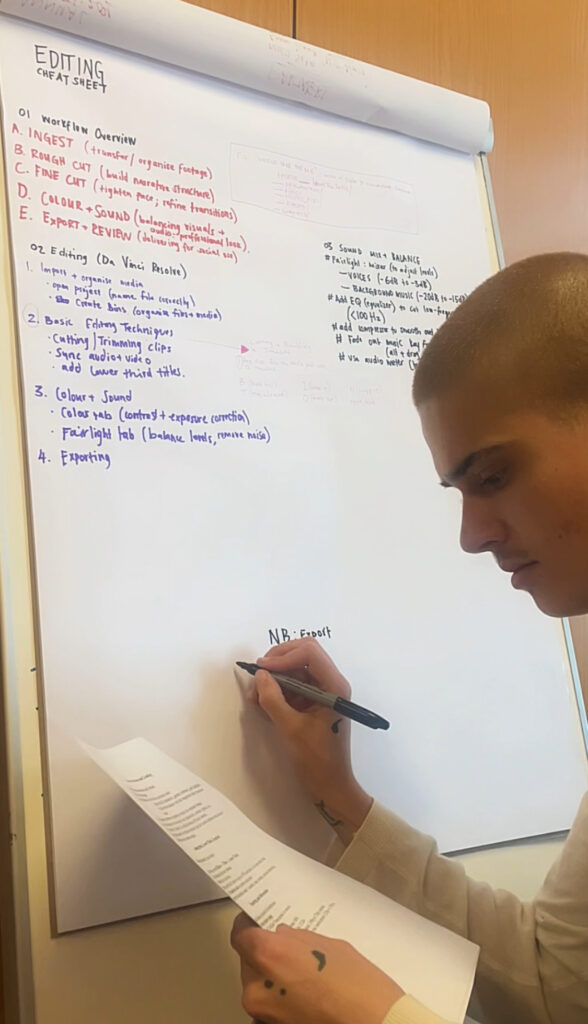
Next, the role of an editor is to refine the transitions and tighten the contents’ pace. You don’t want to have gaps or awkward moments that don’t fit with the narrative flow of the content. This is also where referring to the script or content brief is crucial.
Once the episode is refined, the visual/audio (or both) elements make sense and are synced with care, I move onto the sound and colour grading using Da Vinci Resolve. If this is not a software you have access to, iMovie, CapCut, and even your mobile phone’s gallery editing are suitable to adjust the colour.
Finally, it is time to export and review. Whether you are uploading to YouTube, or submitting content to be screened on television, the delivery of the content should also be handled with as much genuinity as the process of editing. Drive home the intentions and messages behind the content in delivery.
Why iKasi?
I came across iKasi Creative NPC’s call for 2025/26 interns, and was immediately drawn to their aim of placing social media and PR graduates in NPO and NGO spaces to amplify these organisations’ media presence and community engagement.
Since a lot of my volunteer work is in the NGO spaces, I applied to iKasi’s internship hoping to combine the experience I already have with what I expected to learn from this internship from industry professionals. And, given that NGOs and NPOs are dedicated to serving the community, I have taken this opportunity to strategise digital and social media platforms to grow community engagement, and thus impact.
Article by Jude Hunt.